
Introduction: The Physics of the Infinite
In the lifecycle of a technology company, there is a "Phase 1" where scalability is a luxury problem. You optimize for feature velocity, find product-market fit, and handle 10,000 requests per second (RPS) by simply throwing more compute at the problem.
But as you cross the threshold toward 5 billion users, the rules of software engineering undergo a phase shift. You are no longer building an application; you are building a global utility. At this scale, the "one-in-a-million" edge case—the corrupted packet, the simultaneous clock drift, the regional fiber cut—is no longer a statistical anomaly. It is a daily scheduled event.
When your API serves a significant portion of the human population:
- Physics becomes your primary constraint. The speed of light across fiber optics (~200km per millisecond) dictates your UI responsiveness more than your database indexing.
- State is an illusion. Achieving "Strong Consistency" across 12 time zones is not just difficult; it is an act of economic and technical warfare against availability.
- Failure is the default state. At any given second, some portion of your infrastructure—a rack in Virginia, a router in Mumbai, or a disk in Dublin—is currently failing.
This guide is designed for the architects of these systems: Engineers, Solution Architects. We will move past "Intro to Microservices" and dive into the brutal realities of Cell-based architectures, the math of tail latency, and the organizational structures required to keep a system breathing when the internet tries to tear it down.
1. Problem Framing: The Mathematics of 5 Billion Users
To a CEO, "5 Billion Users" is a milestone of global dominance. To a Principal Architect, it is a terrifying distribution of variables that defies traditional vertical scaling. Designing for the planet means managing Global Entropy.
1.1 The Vanity of Registered Users vs. The Physics of Concurrency
"Registered Users" is a database count. "Concurrency" is a resource exhaustion problem.
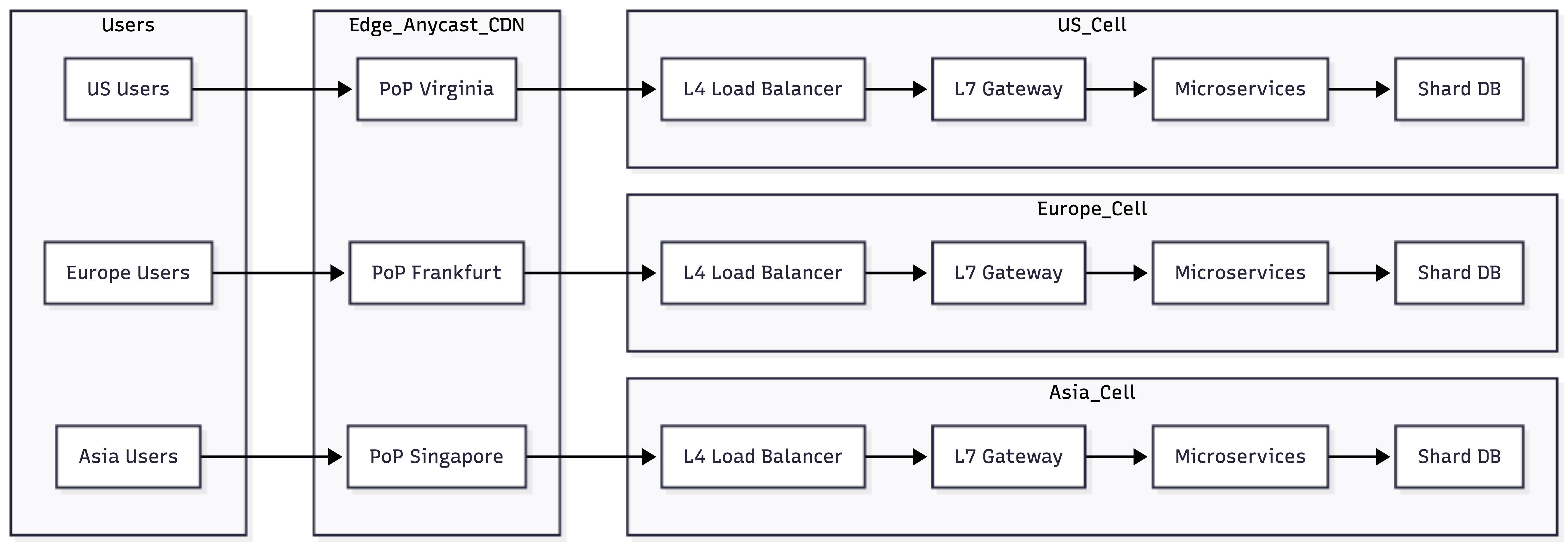
- The Baseline: If 20% of your 5B users are Daily Active Users (DAU), you have 1 Billion people interacting with your API daily.
- The Socket Problem: Assuming an average session length of 5 minutes, you are looking at 3.5 to 5 million concurrent sockets open at any given second.
- Architectural Mandate: At this scale, your OS-level tuning (TCP buffers, file-max limits, ephemeral port ranges) is as critical as your business logic.
1.2 QPS Gradients: The Thundering Herd
Designing for Sustained QPS is an exercise in cost-optimization. Designing for the QPS Gradient is an exercise in survival.
- The Gradient: A global event can spike concurrency from 5M to 50M in <60 seconds. If your autoscaling group takes 3 minutes to warm up a node, you have already experienced a 2-minute total outage.
- Principal’s Note: You don't build for the peak; you build for the velocity of the peak. This requires "Warm Pools" and aggressive request-prioritization at the Edge.
1.3 Latency Modeling: The Tyranny of the p99.9
For an Architect, the mean (p50) is a lie.
- The Math of Scale: At 1 million QPS, a "great" p99.9 means 1,000 users are experiencing terrible latency every single second.
- The Reality: At 5 billion users, your "tail latency" is the daily experience for millions. You don't optimize for the average; you optimize to chop off the tail.
1.4 CAP Trade-offs: PACELC at Planetary Scale
The CAP Theorem is often misunderstood as a choice. At 5 billion users, Partition Tolerance (P) is a physical reality—the internet will partition.
- Availability (A) over Consistency (C): A user in Jakarta seeing a "Like Count" that is 2 seconds out of date is acceptable. A user seeing a 500 Internal Server Error because of a global lock in a US-East data center is an architectural failure.
- Strategic Choice: We design for Eventual Consistency by default, reserving Strong Consistency only for high-value transactional paths (billing/identity), where the latency tax is business-justified.
2. Reliability Philosophy: The Architecture of Managed Failure
The transition to elite technical leadership is marked by one realization: Failure is not an anomaly; it is a system state.
2.1 The Strategic Calculus: SLI, SLO, and the Error Budget
Reliability is not 100%. Reliability is a budgeted probability.
- SLO (Service Level Objective): This is your target (e.g., 99.99% success).
- The Error Budget: If your SLO is 99.99%, you have 4.3 minutes of "allowable" failure per month.
- Leadership Mandate: If the budget is exhausted, all feature work stops. The Engineering Manager (EM) pivots the team to reliability. This creates a shared mathematical incentive between Product (velocity) and Engineering (stability).
2.2 Blast Radius Containment: The "Forest Fire" Model
In a tightly coupled system, a single "poison pill" request can cause a cascading failure that takes down the entire global fleet.
- Containment: Your primary goal is to ensure that a fire in the "Comments Service" doesn't burn down the "Checkout Service."
- Principal’s Note: Use Bulkheads—isolate resource pools (thread pools, connection pools, and memory) so that one failing dependency cannot starve the entire process.
2.3 Cell-Based Architecture: Sharding the World
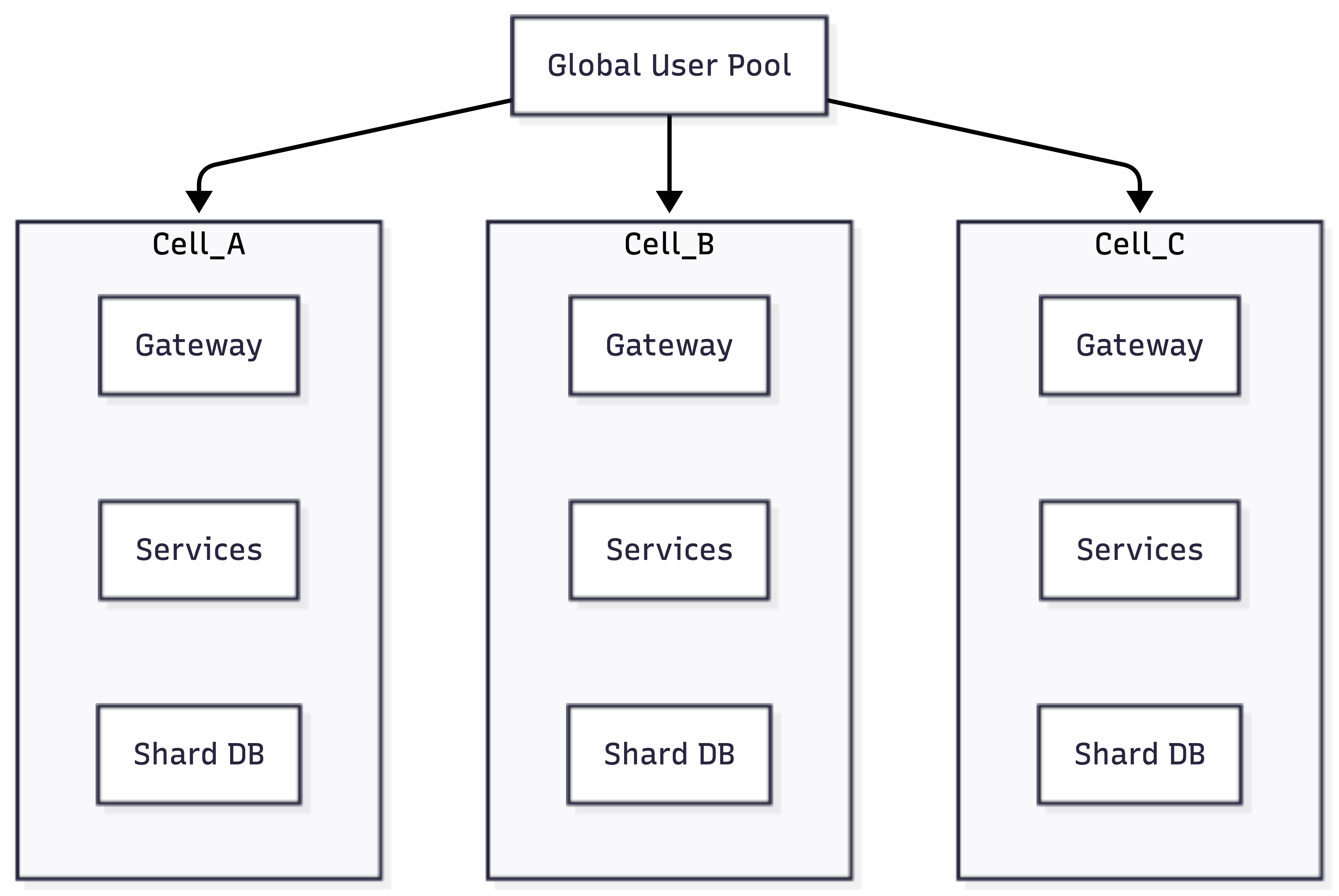
Instead of one massive global cluster, we shard the entire infrastructure into Cells.
- What is a Cell? A self-contained stack (LB -> App -> DB) serving a slice of the population (e.g., 20M users).
- Architectural Insight: At this scale, you don't scale "up"; you scale "out" by replication. If a bad deployment occurs, it kills one cell, not the planet.
2.4 Graceful Degradation (The "Static Resume")
Reliability at scale means knowing what to kill to save the heart.
- Critical Path: Auth, Billing, Core Feed.
- Non-Critical Path: View Counts, "People also liked," Read Receipts.
- The Strategy: When the system detects a "brownout" (CPU > 85% or p99 > 2s), it must automatically shed non-critical features. Serving a cached, "stale" profile is always better than serving a "Fresh" error page.
3. Global Architecture Patterns: Defying the Speed of Light
At 5 billion users, your primary competitor is not another company—it is Latency. Fiber optic signals travel at ~200,000 km/s. A round-trip from Singapore to London is ~160ms of "dead time" before your code even runs. To scale, we must move the compute to the user, not the user to the compute.
3.1 Multi-Region Active-Active: The End of "Failover"
For a Principal Architect, Active-Passive is an unacceptable risk. At this scale, "failing over" to a cold region often leads to an immediate collapse of the secondary region due to empty caches and unprimed connection pools.
- The Strategy: Every region is always "Hot."
- Traffic Steering: Use GSLB (Global Server Load Balancing) with Anycast IP. Traffic is routed to the geographically closest healthy PoP (Point of Presence).
- The N+1 Redundancy: Each region must be provisioned to handle its own load PLUS a fraction of a failed region's load. If you have 4 regions, each must be at <75% capacity to absorb a 25% global failure.
3.2 Edge-First Architecture: Terminating at the PoP
The "Handshake Tax" (TCP + TLS) is the silent killer of API performance.
- Terminating at the Edge: By terminating TLS at a global CDN PoP (Cloudflare, Akamai, or AWS CloudFront), you move the 3-way handshake as close to the user as possible.
- Edge Compute (FaaS at Edge): Move stateless logic—like authentication token validation and request decoration—to the Edge.
- Architectural Insight: The goal is to return a 401 Unauthorized or a 304 Not Modified at the Edge, ensuring that invalid or redundant traffic never enters your expensive backbone network.
3.3 The Shuffle Sharding Standard
Used by AWS and Meta, Shuffle Sharding takes cellular isolation a step further by cryptographically assigning users to specific, non-overlapping subsets of infrastructure.
- The Design: In a standard cellular model, a failure in Cell A affects all users in Cell A. With Shuffle Sharding, we overlap cells in a way that ensures no two users share the exact same failure domain.
- The Impact: This reduces the blast radius of a single "poison pill" request to a vanishingly small percentage of the global population.
- Principal's Mandate: Use Shuffle Sharding for your most critical routing and auth planes. It is the only way to achieve "five nines" of availability at this magnitude.
4. API Gateway & Traffic Engineering: The Intelligent Front Door
At 10M+ QPS, the API Gateway is your primary defense against the "Thundering Herd." It must transition from a simple proxy to an Intelligent Traffic Controller.
4.1 Two-Tier Load Balancing (L4 vs. L7)
High-scale architectures separate "Connection Management" from "Request Intelligence."
- Tier 1: L4 (Network Level - Maglev/NLB): Handles raw TCP/UDP packets. It is blisteringly fast because it doesn't inspect HTTP headers. Its job is to distribute packets across a fleet of L7 proxies.
- Tier 2: L7 (Application Level - Envoy/Service Mesh): This is where the "Brain" lives. It handles TLS termination, gRPC/HTTP2 multiplexing, and path-based routing.
- Architect's Note: Never run business logic at Tier 1. Keep your L4 layer "dumb and fast" to maximize throughput and minimize the attack surface.
4.2 Adaptive Throttling: Moving Beyond "Dumb" Rate Limits
Static rate limits (e.g., 100 req/min) are dangerous. If your backend is at 10% load, a limit is a waste; if it's at 95%, the limit might be too high.
- The Google Model: Implement Adaptive Throttling. The Gateway monitors the backend's "rejection ratio." If the backend starts returning errors or high latency, the Gateway proactively drops traffic before it hits the service.
- Backpressure: When a service is overwhelmed, it must signal the Gateway to "Slow Down" using HTTP 429 or gRPC congestion windows.
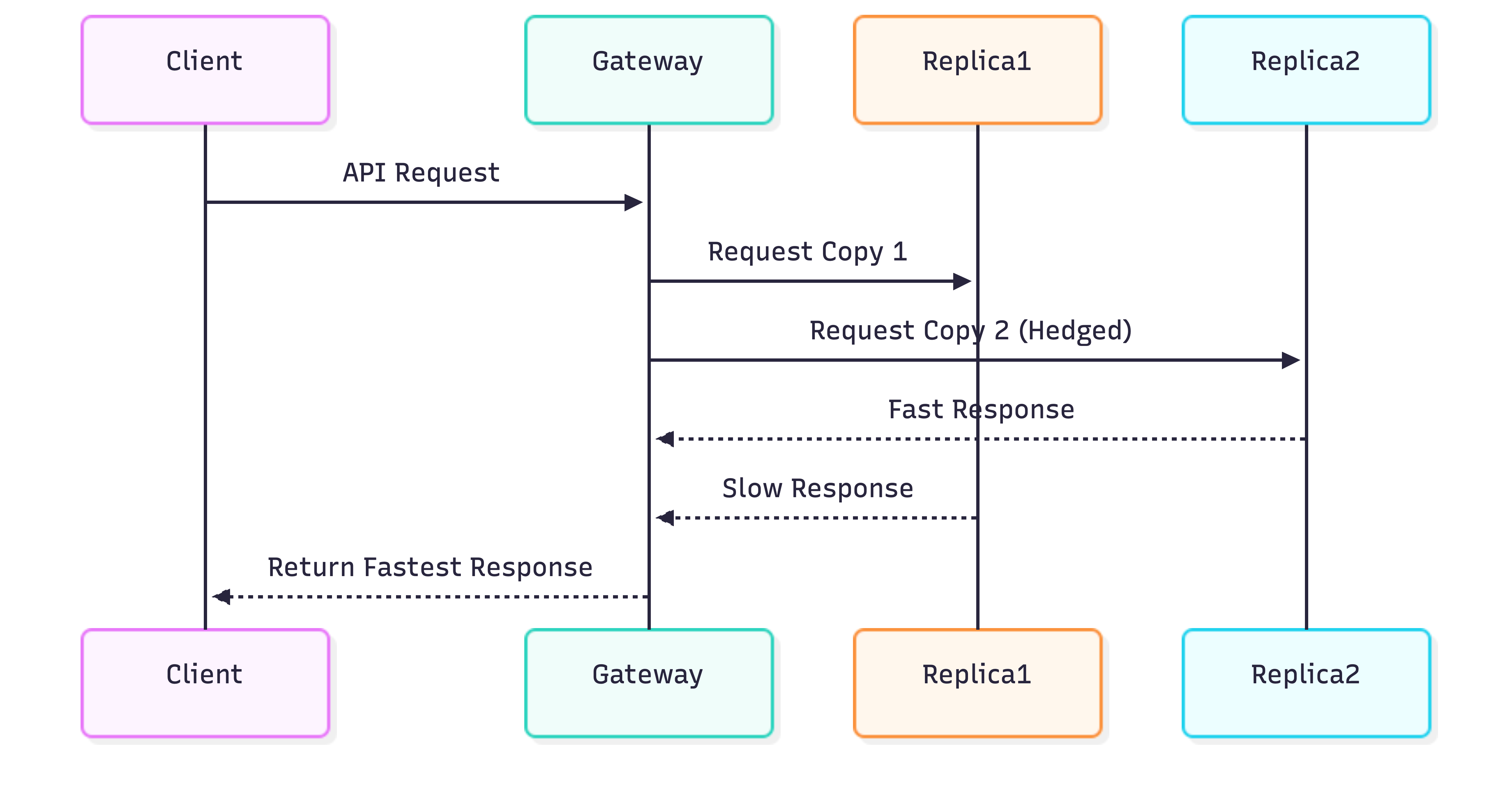
4.3 Hedged Requests: Killing the Long Tail (p99.9)
In a distributed system, a small percentage of requests will always be slow due to GC pauses or network blips.
- The Pattern: Send the same request to two different backend replicas simultaneously. Use whichever response comes back first and cancel the other.
- The Trade-off: This adds ~2% more load to your system but can reduce your p99.9 latency by over 80%. This is how you achieve "Speed of Light" responsiveness at 5B user scale.
5. Data Layer at Planetary Scale: The Physics of State
Data is the hardest part of the 5B user equation. While compute is stateless and "infinite," data is governed by the Write Amplification Tax and Consistency Physics.
5.1 Polyglot Persistence: Matching Model to Access
At this scale, the "Universal Database" is a myth.
- Distributed SQL (Spanner/CockroachDB): Used for the "Source of Truth" (Billing, Identity). It uses Paxos/Raft consensus to provide Strong Consistency globally, but pays a "Latency Tax."
- NoSQL (DynamoDB/ScyllaDB): Used for high-volume metadata (Feeds, Likes). It offers single-digit millisecond latency but requires the application to handle Eventual Consistency.
5.2 Sharding Strategies: Hash vs. Range vs. Geo
- Hash-Based: Best for uniform distribution. Avoids "Hot Shards."
- Range-Based: Better for sequential access, but prone to hotspots (e.g., a viral post).
- Geo-Sharding: Mandatory for compliance (GDPR) and physics. A user in Germany must have their "Home Shard" in Europe to keep local latency low.
- Principal’s Insight: Sharding is a One-Way Door. Changing your Shard Key on a 100PB dataset is a multi-year migration. Choose wisely on Day Zero.
5.3 Storage Engines: B-Trees vs. LSM-Trees
A Solution Architect must understand the disk I/O impact of the database engine.
- B-Trees (Postgres/MySQL): Optimized for Reads. Great for relational data but suffers from random I/O "Write Noise" at scale.
- LSM-Trees (Cassandra/RocksDB): Optimized for Writes. They turn random writes into sequential appends. For high-ingestion APIs (Telemetry, Messaging), LSM-based engines will save you millions in disk IOPS costs.
5.4 The Hot Key Problem & CDC
When a celebrity with 200M followers posts, one specific database record becomes a global bottleneck.
- Mitigation: Use Adaptive Caching. Detect the "Hot Key" at the proxy level and promote it to an in-memory cache (L1) for 30 seconds to bypass the DB entirely.
- CDC (Change Data Capture): Use tools like Debezium/Kafka to stream every DB update. This allows you to update caches, search indexes (Elastic), and analytics (Clickhouse) asynchronously, keeping the API write-path lightning fast.
6. Caching: The Planetary Shield
At 5 billion users, a database query—regardless of how sharded it is—is a high-latency luxury. Caching is not a "performance optimization"; it is the primary shield that prevents your core state-store from vaporizing under the weight of global traffic.
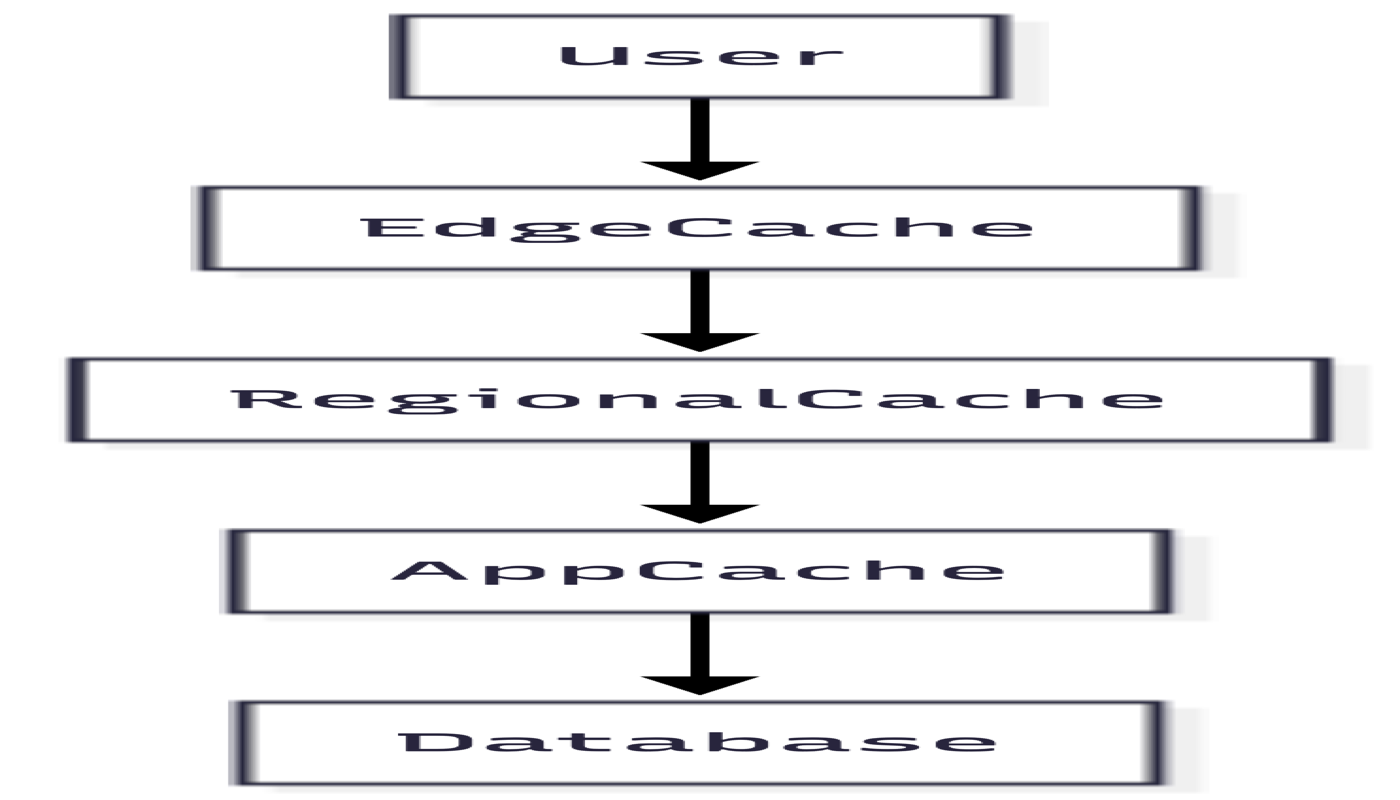
6.1 The N-Tier Caching Hierarchy
We treat RAM as a tiered resource. The goal is to resolve the request as far from the "Source of Truth" as possible.
- L1: Process-Local Cache (In-Memory): Micro-caches inside the application heap. Best for "Immutable Config" or "Global Hot-Keys."
- Principal’s Warning: At this scale, L1 caches cause Cache Incoherency. Use only for data that can tolerate being "stale" for $N$ seconds.
- L2: Regional Distributed Cache (Redis/Memcached): High-throughput clusters shared by services in one region. This is your "Regional Data Plane."
- L3: Edge Cache (CDN): The "Planetary Shield." If a trending post's metadata is cached at the Edge, it never enters your cloud backbone, saving millions in egress.
6.2 The "Hardest Problem": Cache Invalidation & Stampedes
- The Cache Stampede (Dogpile Effect): When a "Hot Key" expires, 100,000 concurrent requests see a "Cache Miss" and hit the DB simultaneously.
- The Solution: Implement Singleflight / Request Collapsing. The first request to see the "Miss" acquires a lock and fetches from the DB; the other 99,999 requests wait and receive the broadcasted result.
- Probabilistic Early Expiration (PER): Instead of letting a key die at exactly $T=60s$, use an algorithm to "randomly" refresh the key at $T=55s$ for a small percentage of requests. This ensures the cache is always "warm" before it officially expires.
- Jitter in TTLs: Never set 1 million keys to expire at the same time. Add a random noise (e.g., $60s + rand(0, 5s)$) to smooth out the load on your backend.
7. Designing for Partial Failure: Preventing the Cascade
In a planetary system, "Uptime" is a binary myth. At any given microsecond, something is broken. Your job is to prevent Total System Collapse.
7.1 The "Timeouts Everywhere" Mandate
The most common cause of global outages is not "crashing"—it is hanging.
- Thread Rot: When a downstream service slows down, the upstream service waits. Threads hang, memory fills up, and eventually, the upstream service exhausts its pool.
- Fail Fast: Set aggressive Connect Timeouts (e.g., 50ms) and Read Timeouts (e.g., 200ms).
- Deadline Propagation: If a user request has a 500ms timeout at the Gateway, that "deadline" must be passed to every microservice in the chain. If Service C receives the request at 480ms, it should stop processing immediately to avoid "Ghost Work."
7.2 Idempotency: The Safety Net for Retries
At 5 billion users, retries are inevitable. Without Idempotency, retries cause data corruption (double-billing, double-posts).
- The Idempotency Key: Every state-changing request must carry a unique UUID. The server stores the result of the first successful execution. If a retry arrives with the same key, we return the cached result without re-executing business logic.
- Architect’s Insight: Idempotency is what allows us to use Asynchronous Workflows (Kafka/Queues) safely.
7.3 Backpressure & Load Shedding
When a "Cell" (Section 3) is overwhelmed, it must have the agency to say "No."
- TCP Backpressure: If the app is slow, the TCP buffer fills, signaling the sender to throttle.
- HTTP 429 (Too Many Requests): Use this to signal the Gateway to steer traffic away from a struggling region.
- Load Shedding: When CPU > 90%, drop "Background Analytics" traffic first, "Social Feed" second, and keep "Payments" alive until the very end.
8. Observability: Managing Global Entropy
At 10M+ QPS, "Monitoring" (logs/metrics) is a financial and technical suicide mission. You cannot log 100% of your traffic. You must move to Intelligent Telemetry.
8.1 The "Billion-Metric" Problem: High Cardinality
If you tag a metric with user_id for 5 billion users, your metrics database (Prometheus/Influx) will crash instantly.
- The Strategy: Aggregated Histograms. Use "Sketching" algorithms (like T-Digest) to maintain accurate p99 percentiles with fixed memory overhead.
- High Cardinality Tooling: Standardize on systems like M3DB or VictoriaMetrics that are designed for high-dimensional data.
8.2 Log Sampling: The Art of Knowing What to Ignore
- Context-Aware Sampling: Log 100% of 5xx errors, but only 0.01% of "200 OK" requests to establish a baseline.
- Tail-based Sampling (Tracing): Decisions to "save" a trace should happen at the end of the request. Only save the trace if:
- It resulted in an error.
- The latency exceeded the SLO (e.g., >500ms).
- It touched a critical "experimental" feature flag.
8.3 From Thresholds to Anomaly Detection
- Static Alerts (e.g., "CPU > 80%"): Are useless at global scale. A 10% traffic drop in India is a disaster at 8 PM but normal at 3 AM.
- Seasonal Baselines: Use Holt-Winters or Prophet algorithms to compare current metrics against "Last Week, Same Time."
- Leadership Mandate: Alert on Symptoms (SLOs), not causes. Don't page an engineer because a server has high CPU; page them because the Error Budget in the Singapore Cell is draining.
9. Chaos Engineering: Verifying the Steady State
At 5 billion users, the statement "It worked in Staging" is an architectural fallacy. Staging cannot replicate the global background noise—the bizarre packet loss in submarine cables or the state-drift of a 100PB database. We move from Testing (verifying knowns) to Chaos Engineering (discovering systemic fragility).
9.1 The Philosophy: Chaos as the Error Budget’s Final Exam
Chaos Engineering is not about breaking things; it is about proving that your Self-Healing mechanisms (Circuit Breakers, Autoscaling, Failovers) actually work under duress.
- The Strategic Rule: Chaos experiments are only allowed if you have a positive Error Budget. If your budget is exhausted, you focus on stability, not experimentation.
9.2 The Three Pillars of Internet-Scale Chaos
- Latency Injection (The Silent Killer): A service that is "dead" is easy to handle. A service that is slow causes "Thread Rot" across the globe.
- Experiment: Inject 300ms of jitter into the Auth-API.
- Verification: Does the Gateway trigger Hedged Requests (Section 4.3)? Do upstream timeouts fire before the thread pool is exhausted?
- Dependency Kill-Switches: In a cellular architecture, every non-critical dependency must be optional.
- Experiment: Physically block traffic to the "Recommendation Engine."
- Verification: Does the UI degrade to a Static Resume (default items), or does it throw a NullPointerException?
- Regional Evacuation (The Nuclear Drill):
- Experiment: Use GSLB to "drain" 100% of traffic from London to Frankfurt.
- Verification: Can the "Warm" region scale fast enough? Does the cross-region DB replication lag cause "Consistency Drifts" that break the business logic?
9.3 Blast Radius Control: The Cellular Strike
You never unleash "Chaos Monkey" on the whole world. You target a specific Cell (e.g., Cell #402 serving 10M users).
- The Automated Abort: Every chaos experiment must have a "Kill Switch" tied to your SLIs. If the error rate in that cell spikes above 0.5%, the experiment must automatically terminate and rollback in milliseconds.
10. API Design: The Infinite Contract
At 5 billion users, your API is a Global Protocol. Once a version is public, it may live for a decade on fragmented mobile devices and IoT sensors. Efficiency is no longer just "clean code"; it is Infrastructure Unit Economics.
10.1 Wire-Format Efficiency: Beyond JSON
At 10M QPS, the serialization/deserialization CPU overhead of JSON is a massive tax.
- The Standard: Protobuf / gRPC. It is binary, strictly typed, and significantly faster to process.
- Field Masking: Allow clients to request only the fields they need (e.g.,
GET /user?fields=id,name). This reduces Over-fetching, saving memory on the server and egress costs on the wire.
10.2 Pagination: The $O(1)$ Mandate
Never use OFFSET and LIMIT.
- The Problem: OFFSET 1,000,000 forces the database to scan and discard 1 million rows. At 5B users, this is a "Resource Exhaustion" event that can lead to cascading database failure.
- The Solution: Cursor-Based Pagination. Use an opaque cursor (Base64 encoded ID/Timestamp). The query becomes
WHERE id > :cursor LIMIT 20. This is a constant-time $O(1)$ operation regardless of how deep the user scrolls.
10.3 Versioning via Transformation Layers
Avoid path-based versioning (/v1/, /v2/) which leads to code-forking.
- Stripe-Style Versioning: Use Header-based versioning (X-API-Version).
- The Transformation Layer: Your backend logic always uses the "Internal Master Version." A thin middleware layer transforms incoming old requests and outgoing responses to match the version requested by the client. This keeps your core business logic clean while supporting "legacy" clients for years.
11. Security: Zero-Trust at Planetary Scale
In a 5-billion-user environment, there is no "Internal Network." We assume the attacker is already inside. Security must be Stateless, Distributed, and Reputation-based.
11.1 Decentralized Auth: Validating at the Edge
You cannot afford a 200ms RTT to a central "Identity Service" for every API call.
- The Strategy: Use JWTs signed with Asymmetric Keys (RS256/EdDSA).
- Edge Validation: The Gateway holds the Public Key and validates the token locally in <1ms.
- The Revocation Problem: To ban a user instantly, push a global Bloom filter or a "Deny-list" to the Edge every few seconds. This is "Eventually Secure" and infinitely scalable.
11.2 mTLS & SPIFFE: Identity over IP
Never rely on IP addresses for security.
- mTLS (Mutual TLS): Every service-to-service call must be encrypted and authenticated.
- SPIFFE/SPIRE: Give every microservice a cryptographically verifiable identity. Service A doesn't just call Service B; it proves it is "authorized" to do so via a short-lived certificate.
11.3 Reputation-Based Throttling
Static rate limits are easily bypassed by distributed botnets.
- Trust Scoring: Assign every request a score based on ASN Reputation (Data center vs. Residential ISP), Account Age, and Behavioral Signatures.
- Dynamic Buckets: High-trust users get a large "Token Bucket." Low-trust or "guest" users are the first to be Load-Shed (Section 7.3) during a traffic spike.
11.4 DDoS Dissipation: The Anycast Shield
A 1-Terabit attack cannot be "absorbed" by your origin. It must be dissipated.
- Anycast Routing: Spread the attack across 400+ global PoPs. A botnet in Brazil is "scrubbed" by the Brazil edge node, ensuring the attack never reaches your primary data centers in Virginia or Dublin.
12. Deployment Strategy: The Art of Invisible Change
At 5 billion users, a "Maintenance Window" is a prehistoric concept. Every deployment is a heart transplant while the patient is running a marathon. We decouple Deployment (moving bits) from Release (exposing users).
12.1 Shadow Traffic (Dark Launching): The Ultimate Load Test
You cannot simulate 10M QPS in a staging environment. The only way to test a new version of the "Search API" is to give it real traffic without the risk.
- L7 Mirroring: The Gateway duplicates the incoming request. It sends it to the "Production" service AND the "Shadow" service.
- The Benefit: The Shadow service processes the request, but its response is discarded.
- Principal’s Note: This allows you to monitor for memory leaks, CPU spikes, and "Correctness" (comparing Shadow vs. Prod output) under 100% real load with zero impact on the user.
12.2 Feature Flags & The "Kill Switch"
At scale, code is "Dark." Every new feature is wrapped in a conditional toggle.
- Decoupled Release: You deploy the code on Monday, but you only "turn it on" via a config update on Thursday.
- Targeted Blast Radius: Start by enabling the flag for 0.01% of users in a single "Cell." If p99s remain stable, ramp up.
- The Emergency Stop: If a new feature causes a DB deadlock at 3 AM, you don't "Rollback the Build" (which takes minutes). You flip the flag to OFF (which takes milliseconds).
12.3 Database Schema Evolution: Expand & Contract
You can rollback code, but you cannot "rollback" a 100TB database migration without data loss.
- The Five-Step Dance:
- Expand: Add the new column (allow NULLs).
- Dual Write: Update code to write to both old and new columns.
- Backfill: Run a background job to migrate old rows.
- Read: Switch code to read from the new column.
- Contract: Delete the old column.

- Architect’s Mandate: Never perform a "Breaking Change" on a database. Compatibility must be maintained across versions.
13. Cost Engineering: The Unit Economics of Scale
At 5 billion users, an inefficient index or a bloated JSON response is a multi-million dollar financial leak. Cost is not a finance problem; it is an architectural constraint.
13.1 Unit Cost: The "Cost per Request" KPI
Stop looking at "Monthly Cloud Bill." Start looking at Unit Economics.
- The Goal: Total Infra Cost / Total Successful Requests.
- Optimization: Moving from x86 to ARM64 (Graviton) can provide up to 40% better price-performance. Principal Engineers tune the Garbage Collector (GC) and thread-pools specifically to maximize "Requests per Dollar."
13.2 The Networking Tax: Egress and Cross-AZ Costs
In global systems, "Data Transfer" often costs more than "Compute."
- Zone-Aware Routing: Ensure a service in us-east-1a always talks to a DB replica in us-east-1a. Crossing Availability Zones (AZs) is a hidden tax.
- CDN Offloading: Every request resolved at the Edge (Section 6) saves you "Cloud Egress" fees. Aggressive caching is your best financial strategy.
13.3 Storage Tiering: Hot, Warm, Cold
You cannot keep 5B users' historical data on high-IOPS SSDs.
- The Tiering Strategy: Use TTL-based eviction.
- Hot: Last 30 days (SSD/In-memory).
- Warm: Last 1 year (Standard Disk).
- Cold: >1 year (S3 Glacier/Object Storage).
- Solution Architect’s Note: Designing the "Data Lifecycle" is just as important as designing the "Data Schema."
14. Organizational Architecture: Conway’s Law in Action
Systems fail because of team structures, not just syntax errors. You cannot build a Cellular API with a Monolithic Team.
14.1 The "Paved Road" (Platform Engineering)
At internet scale, you cannot expect 1,000 developers to be experts in mTLS or BGP.
- The Strategy: The Platform Team builds the "Paved Road"—standardized CI/CD, sidecars, and templates.
- The Rule: If a team stays on the Paved Road, they get "Auto-Scaling" and "Security-by-Default." If they go "Off-Road," they own the operational burden themselves.
14.2 Cognitive Load Management
A single engineer cannot understand 200 microservices.
- Service Tiering: Divide services into Tier-1 (Critical Path) and Tier-3 (Auxiliary).
- Institutional Memory: Use ADRs (Architecture Decision Records). Documentation should explain Why a decision was made (e.g., "Why we chose DynamoDB over Postgres"), not just What the system does.
15. The Hard Truth: Resilience Over Perfection
As we reach the 5-billion-user milestone, we must accept the ultimate paradox: The more you design for "Never Fail," the more you must accept that your system is currently, and will always be, failing.
15.1 Reliability is a Probability
There is no such thing as 100% uptime. There is only Controlled Degradation.
- 99.99% is a strategic choice. It gives you an Error Budget to take risks.
- If you are "too reliable," you are not moving fast enough.
15.2 The Mindset Shift: The System Must "Dim," Not Go Dark
Elite technical leadership is about managing the Spectrum of Failure.
In a crisis, we don't let the whole system crash. We disable "View Counts," we turn off "Recommendations," and we protect the "Login" and "Payment" paths.
The Conclusion: Architecture is a Choice, Not a Destination
As we have explored across these fifteen sections, a mature internet-scale architecture is far more than a collection of small APIs; it is a complex socio-technical ecosystem.
True architectural leadership lies in knowing when to decompose and, more importantly, when to stay monolithic. Microservices are not a silver bullet; they are a scalpel. They are capable of performing delicate organizational surgery when used correctly, but are dangerous in the hands of the uninitiated.
Build with intent, monitor with rigor, and never stop evolving.
Need Help Scaling to the Next Billion?
Building resilient, high-scale APIs requires a deep understanding of distributed systems and pragmatic trade-offs. If your platform is hitting its limits, let's architect a solution that survives the infinite.