
Introduction: The Invisible Tether
You've done everything by the book. You've decomposed your monolithic application into twenty distinct services. You have a sleek Kubernetes cluster, a sophisticated CI/CD pipeline, and your teams are organized into "Two-Pizza" squads. On your architectural diagram, the boxes are separate. In your standups, you talk about "autonomy."
But then, an engineer on the Order Service team needs to change a column name from user_id to customer_uuid to comply with a new global identity standard.
Suddenly, the "autonomy" vanishes.
The Shipping Service team complains that their queries will break. The Analytics team says their ETL jobs will fail. The Billing team notes that their stored procedures rely on that specific column name. What was supposed to be a fifteen-minute schema migration turns into a three-week cross-team "alignment meeting" and a coordinated "Big Bang" deployment on a Saturday night.
If this sounds familiar, you aren't running microservices. You are running a Distributed Monolith.
The culprit is the Shared Database Trap. While your compute layer is distributed, your data layer remains a single, massive point of coupling. By sharing a database across service boundaries, you have created a "hidden API" that lacks versioning, lacks encapsulation, and — most importantly — destroys the very thing microservices were designed to deliver: Independent Deployability.
In this deep dive, we will explore why the shared database is the ultimate "Architectural Gravity," how it creates a ceiling for your engineering velocity, and the high-level patterns senior leaders must implement to truly decouple their data.
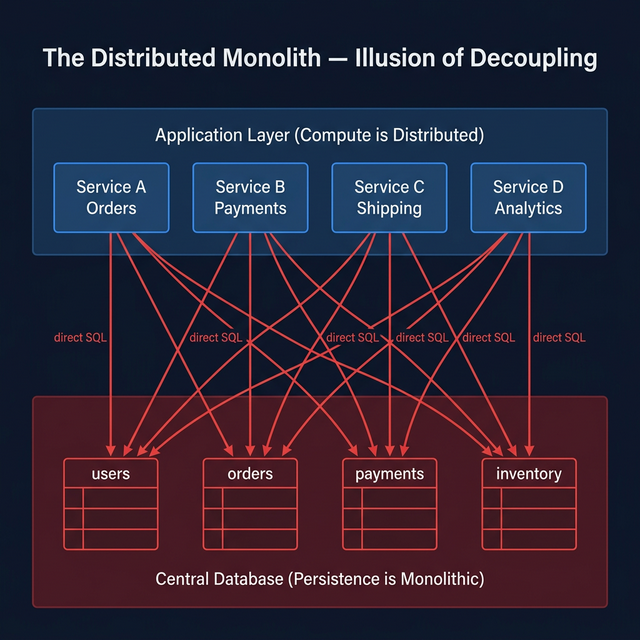
The Distributed Monolith: Decoupled in the IDE, but tightly coupled in production.
Why This Matters at Every Layer
At the release cadence level, the shared database is the invisible bottleneck. You can migrate to the cloud, containerize everything, and adopt Kubernetes — but if your teams still need "Schema Alignment Meetings" before every deployment, the release frequency problem has not moved; it has just relocated from the application layer to the persistence layer.
At the fault isolation level, this is about Blast Radius. In a correct microservices design, a failure in the Inventory Service must not be able to lock the tables of the Payment Service. When services share a database, they share not just data — they share a failure domain. A corrupted index or a runaway query in one domain becomes an outage for the entire system.
In the following sections, we will dissect the anatomy of this trap and provide the engineering principles and patterns needed to break the chains of shared persistence.
1. The Anatomy of the Trap: Defining the Problem
The primary objective of a microservices architecture is Independent Deployability. If a change in one service requires a coordinated deployment of another, the architecture has failed its core mission. In many modern systems, while the application code is physically separated into distinct containers or serverless functions, the persistence layer remains a single, monolithic entity. This creates a Distributed Monolith: a system that inherits the complexity of distributed systems without gaining the benefits of modularity.
1.1 The Definition of Persistence-Layer Coupling
In a monolith, the database is a private implementation detail. In a true microservices environment, each service should encapsulate its own state. When multiple services point to the same database instance — and specifically the same schemas or tables — the database ceases to be an internal detail and becomes an unmanaged integration point.
This is "backdoor coupling." Even if Service A and Service B have no direct synchronous dependencies (like REST or gRPC calls), they are inextricably linked through the database schema. If Service A modifies a table structure to support a new feature, Service B may fail at runtime. This dependency is often invisible until the moment of deployment, leading to brittle systems and "Big Bang" release requirements.
1.2 The "Shared Schema" as an Unversioned API
When two services access the same table, that table's schema effectively becomes a Public API. However, unlike a standard API (which would have versioning, request validation, and documentation), a database schema is usually unversioned and implicit.
- The Contract Problem: In a standard service-to-service call, Service A provides a contract. In a shared database, the "contract" is the DDL (Data Definition Language).
- The Enforcement Gap: There is no middleware to enforce how Service B uses Service A's data. Service B can write invalid data, bypass business logic enforced in Service A's code, or create indexes that degrade Service A's query performance.
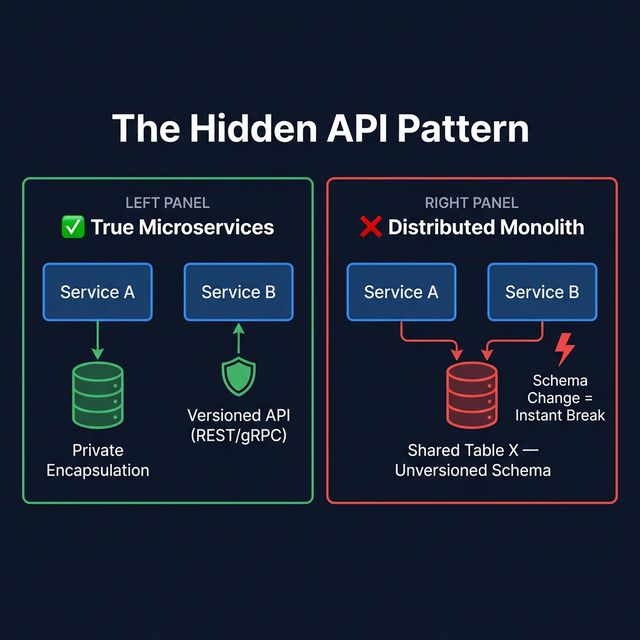
Physical separation of compute does not equate to architectural decoupling if the persistence layer is shared.
1.3 The "Distributed Monolith" Litmus Test
To determine if an architecture has fallen into the shared database trap, evaluate the system against these three technical indicators:
- The Schema Change Test: Can a developer rename a column or change a data type in Service A without performing a code audit of Service B, C, and D? If the answer is no, the services are not decoupled.
- The Synchronized Deployment Test: Does the CI/CD pipeline require multiple services to be deployed simultaneously to handle a database migration? If "Service A" and "Service B" must go live together to avoid SQL Grammar Errors, you are running a monolith across the network.
- The Database-Driven "Join" Test: Do services perform cross-domain JOINs at the SQL level? If the Order Service joins the Product table and the User table in a single query, it has bypassed the domain boundaries of the Product and User services.
1.4 The Fallacy of "Logical Isolation"
Many engineering teams attempt to mitigate the shared database trap by using "Logical Isolation" — separate schemas or namespaces within the same physical database instance. While this is a step toward better organization, it often fails to solve the underlying engineering constraints:
- Resource Contention: All "logically isolated" services still compete for the same CPU, Memory, and Disk I/O. A spike in Service A can still starve Service B.
- The Temptation of the Cross-Schema Query: As long as the data is physically co-located, developers will eventually write cross-schema queries to avoid the overhead of API composition. This "path of least resistance" inevitably leads back to tight coupling.
The "Distributed Monolith" is an architectural state where the overhead of network communication and distributed systems is present, but the agility of independent scaling and deployment is absent.
2. Technical Debt — The Anatomy of the Trap
In a healthy microservices architecture, the database is a private implementation detail. When that database is shared across service boundaries, it undergoes a fundamental transformation: it ceases to be an internal storage mechanism and becomes a primary integration point.
This shift introduces a compounding form of technical debt that is often invisible during the initial stages of growth but becomes a systemic blocker as the platform scales.
2.1 The Schema as a Shadow API: Contractual Fragility
In standard service-to-service communication, APIs (REST, gRPC) serve as explicit contracts. These contracts are versioned, documented, and enforced by middleware. When multiple services query the same tables, the Database Schema becomes a Shadow API.
Unlike a formal API, however, the database lacks the technical guardrails required for distributed systems:
- Zero Versioning: There is no "v2" for a physical table schema. A DDL change — such as dropping a column or modifying a data type — is an immediate, breaking change for every service pointing at that table.
- Implicit Consumption: In an API-driven model, you can trace consumers via headers or API keys. In a shared database, it is technically difficult to identify which service is responsible for which query without exhaustive audit logging, making "safe" refactoring nearly impossible.
- The Leakage of Internal State: Internal optimizations (like denormalizing a table for performance) are exposed to every consumer. This prevents the "owning" service from evolving its data model without coordinating a migration across the entire ecosystem.
2.2 Resource Contention and the "Noisy Neighbor" Effect
Microservices are designed to provide fault isolation. A shared database creates a physical SPOF (Single Point of Failure) where the resource demands of one domain can degrade the performance of others.
The IOPS and CPU Bottleneck:
Even if services are logically separated by schemas, they share the same underlying hardware resources:
- Disk I/O Saturation: An unoptimized
SELECT *or a massive index rebuild in a background worker service can saturate the disk I/O (IOPS), causing the latency of high-priority transactional services to spike. - Buffer Cache Contention: The database's memory (Buffer Pool) is a shared resource. If Service A performs a large table scan, it flushes the "hot" data used by Service B out of memory, forcing Service B to hit the disk for every query.
Lock Contention at Scale:
In a shared RDBMS, ACID guarantees are enforced through locking. If Service A initiates a long-running transaction on a table that Service B also relies on, Service B is forced into a WAIT state. In high-concurrency environments, this leads to transactional gridlock, where the throughput of the entire system is limited by the longest-running transaction in any service.
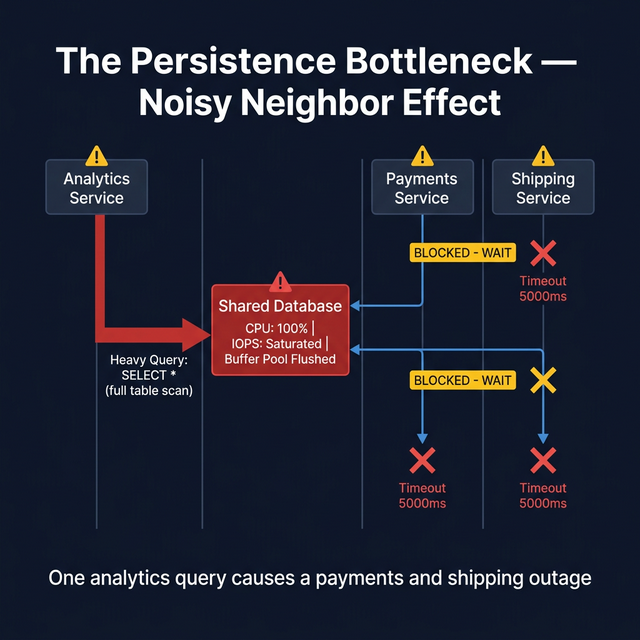
Resource contention turns independent services into a single failure domain.
2.3 The Connection Pool Mathematical Limit
Every database instance has a hard limit on concurrent connections (max_connections). In a monolithic architecture, a single application manages its connection pool efficiently. In a microservices environment, this becomes a mathematical liability.
If an organization has 20 services, and each service scales horizontally to 10 instances to handle a traffic spike, and each instance maintains a minimum pool of 10 connections:
20 services × 10 instances × 10 connections = 2,000 active connections.
Most standard database configurations begin to see significant performance degradation well before hitting several thousand connections. When the limit is reached, the database rejects new connections, causing a cascading failure across all services, regardless of which service actually needs the scale.
2.4 The Erosion of Security Boundaries
The Principle of Least Privilege is a cornerstone of secure systems. In a shared database, enforcing granular security is operationally intensive:
- Over-Privileged Credentials: To simplify development, services often use a shared service account with read/write access to the entire database. If a low-criticality service (e.g., a "Marketing Banner" service) is compromised, the attacker gains immediate access to "Payment" or "User" tables.
- Audit Trail Obfuscation: When 50 services use the same database, identifying the source of a malicious or accidental data deletion requires correlating application logs with database binlogs/WAL (Write-Ahead Logs). This adds hours of latency to incident response.
- Bypassing Business Logic: Shared databases allow services to bypass the "owner" service's business rules. If the Account Service has logic to validate an address, but the Shipping Service writes directly to the
addressestable, it can insert invalid data the Account Service is not prepared to handle.
The technical debt of a shared database is not merely "messy code" — it is a violation of the fundamental principles of distributed systems.
3. Operational Gridlock — Deployment & Scalability
While the technical debt of a shared database erodes the codebase, the operational gridlock erodes engineering velocity. Microservices are intended to allow teams to move at different speeds. However, a shared database acts as a "global synchronization point," forcing independent services into a rigid, lock-step cadence that mirrors the very monolith they were meant to replace.
3.1 The Deployment Cascade: Synchronized Releases
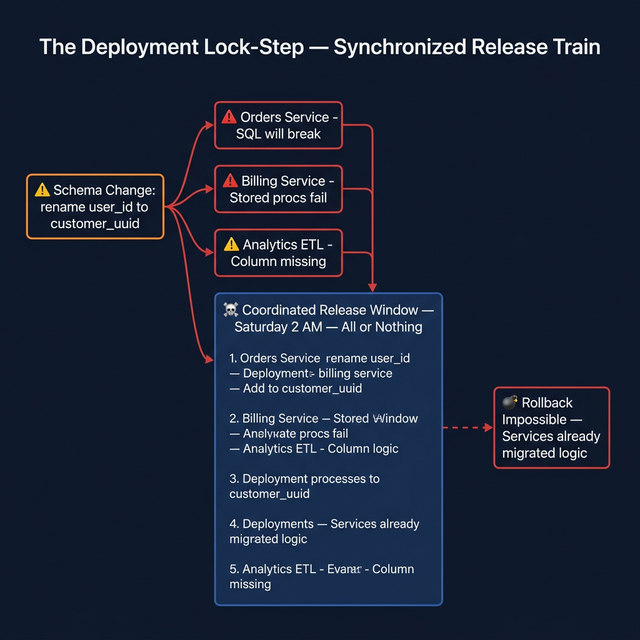
The primary metric of a successful microservice architecture is the ability to deploy a single service without touching any other part of the system. A shared database fundamentally breaks this capability through DDL coupling.
If Service A requires a destructive schema change (e.g., dropping a column, changing a data type, or renaming a table) to support a new feature, every other service querying that table is immediately at risk.
- The Result: Deployments turn into "Big Bang" events. Engineers must coordinate "Release Trains" where five different services are deployed in a specific sequence to ensure no service is left running against an incompatible schema.
- The Rollback Nightmare: If a deployment fails, rolling back Service A is impossible if Service B has already migrated its logic to the new schema. This leads to "Forward-only" deployment cultures, which significantly increases the risk profile of every production change.
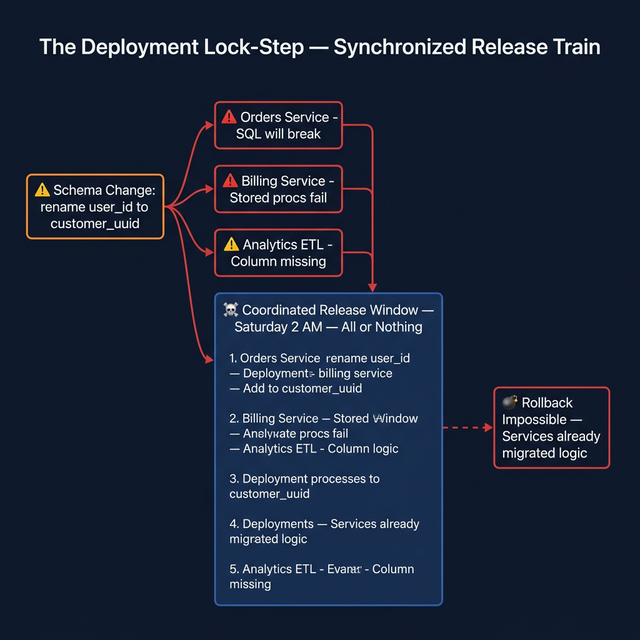
Shared persistence eliminates independent deployability, turning microservices into a distributed release train.
3.2 Distributed Concurrency and "Heisenbugs"
In a shared database environment, the database engine's lock manager becomes the arbiter of the entire system's concurrency. This leads to non-deterministic failures that are notoriously difficult to debug — often referred to as Heisenbugs.
- Cross-Service Deadlocks: Service A updates
Table_XthenTable_Y. Simultaneously, Service B updatesTable_YthenTable_X. Because they share the same physical database instance, they trigger a deadlock. Since these services are running in different process spaces, tracing the root cause requires correlating logs across multiple distributed systems and database internal traces. - Hidden Transactional Dependencies: A long-running transaction in a background worker (e.g., a "Monthly Report" service) can hold a Shared (S) lock on a table, blocking an "Update" service from acquiring an Exclusive (X) lock. This manifests as intermittent timeouts in high-priority transactional services that have no apparent connection to the background worker.
3.3 The Scaling Ceiling: Vertical vs. Horizontal
Microservices are designed to scale horizontally. However, when those pods all point to a single shared database, the bottleneck simply shifts from the compute layer to the persistence layer.
The Write Bottleneck:
- While read replicas can offload SELECT traffic, the primary writer remains a single point of contention.
- In a shared database, all write-heavy services (Orders, Payments, Inventory) compete for the same transaction log (WAL/binlog) and the same disk throughput.
- Once the primary instance hits its maximum IOPS or CPU capacity, the only remaining option is Vertical Scaling (buying a larger instance). Vertical scaling has a hard physical ceiling and follows a law of diminishing returns.
The Failure Domain Expansion:
In a decoupled architecture, a database outage only affects one service. In a shared database architecture, a single storage failure, a misconfigured vacuum/autovacuum process, or a corrupted index results in a total system blackout. The blast radius is 100%.
3.4 CI/CD Fragility and Environment Bloat
- Data Masking and Volume: To test Service A, developers often need a full clone of the shared database to ensure that cross-service queries work as expected. Cloning a multi-terabyte shared database for every ephemeral branch environment is both slow and cost-prohibitive.
- Staging Contention: If Team A is running a load test against their service in the integration environment, they effectively block Team B from doing functional testing because the shared database resources are saturated. This creates a queue for the "Testing Environment," further slowing down the Path to Production.
The "Shared Database Trap" forces an organization to adopt the operational overhead of distributed systems without the benefit of the Decoupled Lifecycle.
4. Deep Tech — Decoupling Patterns for the Architect
Decoupling a shared database is not merely a task of "moving tables." It requires a fundamental shift in how the system handles state, consistency, and data retrieval. For systems operating at scale, the transition involves moving from Synchronous Coupling (SQL Joins) to Asynchronous Coordination (Events and Streams).
4.1 The Isolation Spectrum: Logical to Physical
The journey to data independence typically follows a maturity model. Jumping straight to 50 separate database instances is often operationally catastrophic. Instead, architects should move through levels of isolation:
- Level 1: Logical Isolation (Separate Schemas): Move tables into service-specific schemas (e.g.,
orders_schema,billing_schema) within the same physical instance. Grant each service account access only to its schema. This prevents "accidental" cross-service queries but does not solve resource contention. - Level 2: Physical Isolation (Database-per-Service): Each service owns its own database instance (or cluster). This provides complete fault isolation and independent scaling of IOPS/Memory.
4.2 The "Dual-Write" Problem and the Transactional Outbox Pattern
When you split databases, you lose the ability to perform a cross-domain ACID transaction. If Service A updates its database and then attempts to send a message to Service B, a network failure between the DB commit and the message dispatch creates data inconsistency.
The Transactional Outbox Pattern is the standard solution for ensuring atomicity across distributed boundaries without using slow, brittle Two-Phase Commits (2PC):
- The Local Transaction: Service A updates its internal state (e.g.,
ORDER_TABLE) and simultaneously inserts a message into anOUTBOXtable within the same local transaction. - The Relay: A separate process (a Message Relay or a CDC tool) polls the
OUTBOXtable or monitors the database log. - The Dispatch: The relay publishes the message to a broker (Kafka, RabbitMQ) and marks the outbox entry as processed.
This ensures at-least-once delivery and maintains the integrity of the service's bounded context.
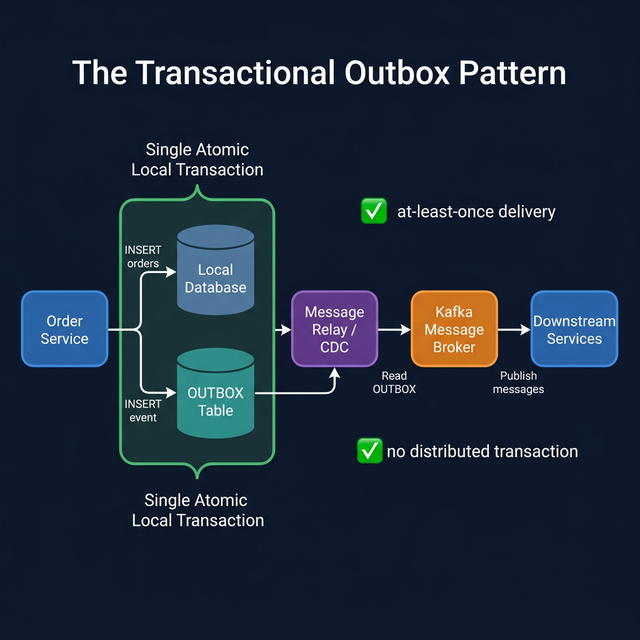
Ensuring consistency across distributed services without distributed transactions.
4.3 Change Data Capture (CDC): Streaming the Log
For high-throughput systems where polling an OUTBOX table creates unacceptable overhead, Change Data Capture (CDC) is the preferred "Deep Tech" solution.
By using tools like Debezium, the system reads the database's transaction log (the WAL in Postgres or Binlog in MySQL) directly. This allows the system to stream every row-level change as an event to a message bus.
- Benefit: Zero impact on application logic.
- Trade-off: Requires sophisticated infrastructure to manage the log-reading offset and ensure events are not lost during network partitions.
4.4 API Composition vs. CQRS
Once data is physically isolated, performing a "Join" becomes a distributed problem. There are two primary patterns to resolve this:
-
API Composition (The Join-in-Memory): An "Aggregator Service" calls Service A and Service B via REST/gRPC and joins the results in application memory.
- When to use: Low complexity, low data volume.
-
CQRS (Command Query Responsibility Segregation): If a query requires complex joins across multiple domains, Service C maintains a Read Model (a "Projection"). Service C listens to events from Service A and Service B, materializing the data into a specialized view (often in a NoSQL store like Elasticsearch or a denormalized Postgres table) optimized specifically for that query.
- When to use: High complexity, high data volume, or real-time aggregation requirements.
4.5 Handling Reference Data: The "Shared Table" Exception?
A common hurdle is "Reference Data" (e.g., Country Codes, Currency Codes). Do you really need a "Country Service"?
- Pattern — The Local Cache/Sidecar: Instead of a shared table, distribute reference data as a library or a seeded table in every service's local DB.
- Pattern — Event-Driven Replicated State: If the reference data changes (e.g., Tax Rates), the "Owner" service broadcasts an update, and all consuming services update their local copies.
Decoupling the persistence layer is a transition from Direct Access to Managed Ownership. By implementing patterns like the Transactional Outbox and CQRS, architects trade the simplicity of a single SQL connection for the resilience and scalability of an asynchronous, event-driven ecosystem.
5. Strategic Reality — When is a Shared Database Pragmatic?
Architectural purity is rarely the primary goal of a production system; the goal is to balance velocity, cost, and complexity. While this article has focused on the "trap" of the shared database, a senior architect must also recognize when a shared persistence layer is a calculated, strategic choice rather than an accidental anti-pattern.
Understanding the "Tipping Point" — where the benefits of a shared database are eclipsed by its coordination costs — is a critical skill for technical leadership.
5.1 Strategic Tech Debt: The "Zero to One" Phase
In the early stages of a product's lifecycle, the primary risk is not "architectural coupling," but market irrelevance.
- The Case for Shared Persistence: When a team is small (e.g., fewer than 10 engineers) and the domain boundaries are still fluid, the overhead of managing 20 separate database instances, distributed transactions, and event-driven synchronization can paralyze development.
- Logical vs. Physical Velocity: At this stage, the ability to perform a cross-domain SQL JOIN is an asset that allows for rapid feature iteration. The "Shared Database" acts as a deliberate "Buy-Now-Pay-Later" technical debt that accelerates initial delivery.
5.2 The "Modular Monolith" as an Intermediate State
A shared database is most effective when paired with a Modular Monolith approach rather than a microservices approach:
- The code is partitioned into distinct modules (e.g., using Java Modules or Go Packages).
- The database is partitioned into distinct schemas (Logical Isolation).
- The Constraint: Only the corresponding module is allowed to query its schema.
This provides a path to future decoupling without the operational tax of distributed systems. It allows the system to remain on a single physical instance — simplifying backups, monitoring, and ACID compliance — until the scale of the organization or the traffic demands physical separation.
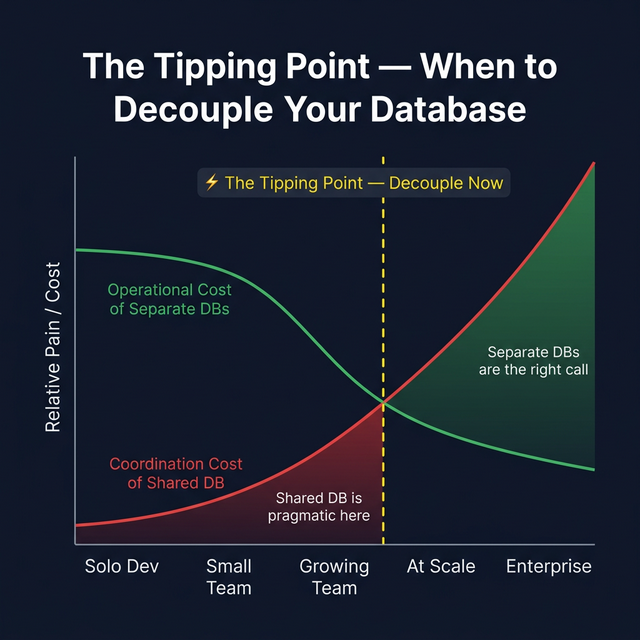
The transition to Database-per-Service should be driven by the cost of coordination, not by architectural dogma.
5.3 Indicators for Migration: Identifying the Tipping Point
How do you determine when a shared database has transitioned from a "strategic asset" to a "systemic liability"? The following technical signals indicate the need for immediate decoupling:
- Deployment Frequency Decay: When the lead time for a simple feature increases because of "Schema Alignment Meetings" or "Pre-deployment Impact Analysis" across multiple teams.
- Hardware Ceiling (The Vertical Limit): When the primary database instance is already on the largest available cloud instance type (e.g., an AWS
r6g.32xlarge) and CPU/IOPS saturation continues to climb. - The "Team Friction" Metric: When Team A frequently breaks Team B's environment due to unannounced schema migrations or index changes that alter query plans globally.
- Security/Compliance Hardening: When a new regulatory requirement (like data residency or strict PII isolation) makes "Logical Isolation" legally insufficient.
5.4 The Operational Maturity Prerequisite
Decoupling the database layer requires a high level of Operational Maturity. If the infrastructure team cannot yet automate the provisioning, patching, and backing up of multiple database instances, moving to a "Database-per-Service" model will replace "Schema Coupling" with "Operational Exhaustion."
Before breaking the shared database, the following must be in place:
- Automated Provisioning: (Terraform, CloudFormation, or Crossplane).
- Standardized Observability: Centralized logging and tracing (OpenTelemetry) to track requests across database boundaries.
- Standardized Migration Tooling: (Liquibase, Flyway) integrated into CI/CD pipelines.
A shared database is not a "fail" if it is a conscious decision backed by a clear understanding of the trade-offs. The "Trap" occurs when the architecture remains in a shared state long after the organization has outgrown the "Zero to One" phase.
6. The Migration Roadmap — Breaking the Chains
Decoupling a shared database in a production environment is the architectural equivalent of performing heart surgery while the patient is running a marathon. A "Big Bang" migration is almost always a recipe for catastrophic failure and extended downtime.
Instead, senior architects must employ a Phase-Shift Approach, utilizing the "Strangler Fig" pattern for data to incrementally migrate state without disrupting system availability.
Step 1: The "Audit and Ownership" Phase (Stop the Bleeding)
Before moving a single row of data, you must establish Service-Level Ownership.
- The Audit: Use database features like
pg_stat_statements(Postgres) or Extended Events (SQL Server) to identify every unique source IP and user agent hitting a specific table. - The Proxy Policy: Identify the "Logical Owner" of a table (e.g., the Inventory Service owns the
stocktable). Prohibit all other services from writing to this table directly. - The API Facade: Force "Consumer Services" to move from direct SQL queries to calling the Owner Service's API. This replaces hard schema coupling with soft contract coupling.
Step 2: Logical Separation (The Schema Sandbox)
If the tables are currently co-located in a single public schema, move them into service-specific namespaces (schemas).
- Encapsulation via Permissions: Create a dedicated database user for each service. Revoke
SELECT/INSERT/UPDATEpermissions on any table not belonging to that service's schema. - Cross-Schema Views (Temporary): If Service B still requires "Read" access for performance, provide a Database View instead of direct table access. This allows the Owner Service to change the underlying table structure while keeping the View stable for the consumer.
The API acts as a "decoupling layer," allowing the physical data migration to be invisible to the rest of the system.
Step 3: The "Shadow Move" (Syncing State)
To move data to a new physical instance with zero downtime, use Change Data Capture (CDC) or Trigger-based Replication.
- Provision the New DB: Set up a dedicated instance for the service.
- Continuous Sync: Use a tool like Debezium or AWS DMS to stream all changes from the "Legacy" table to the "New" table in real-time.
- The Shadow Write: Update the service code to write to both the old and new databases (Dual Writing) or rely on the CDC stream to maintain parity.
Step 4: The Cut-Over (Traffic Shifting)
Once the new database is in sync and latency is verified, perform the cut-over:
- Read-Switch: Move all "Read" operations in the service to the new database. Monitor for performance regressions.
- Write-Switch: Update the service to write only to the new database.
- The Deletion: Keep the legacy table for a "Cool-down" period (7–14 days) before finally dropping it from the original shared instance.
Step 5: Managing Cross-Cutting Reference Data
One of the hardest parts of breaking the shared database is dealing with Foreign Key Constraints that span services.
- Reference Data Replication: For "read-only" data like Country Codes or Tax Categories, replicate the data to each service's local database.
- ID-Only References: Replace hard Foreign Keys with "Logical Keys" (UUIDs). Service A stores the
user_idbut no longer has a hard database constraint linking it to theuserstable in another database. Consistency is now enforced at the Application Layer or through Asynchronous Reconciliation scripts.
Conclusion: Beyond the Buzzwords
The "Shared Database Trap" is the most common reason microservice migrations fail to deliver on their promise of agility. While it offers a comfortable path forward during the early stages of a system's life, it eventually becomes an Architectural Ceiling that prevents independent scaling, creates deployment gridlock, and expands the blast radius of every failure.
The core engineering principles to act on are clear:
- Recognize the shared database as a high-interest technical loan — one that compounds with every team added and every feature shipped.
- Decouple when the "Coordination Cost" of schema alignment meetings and synchronized deployments begins to exceed the "Implementation Cost" of proper service boundaries.
- Migrate incrementally through API encapsulation and asynchronous patterns like the Transactional Outbox — never in a Big Bang.
True microservices are defined by their autonomy. If your data isn't autonomous, neither are your services.
Key Takeaways
Ready to Break the Chains?
Decoupling a shared persistence layer in production requires careful sequencing and a deep understanding of distributed systems trade-offs. If your platform is hitting the wall of operational gridlock, let's design an architecture that reclaims your team's autonomy.